
A multi processor setup for high-risk merchants is often the difference between stable growth and constant payment friction. For many online businesses operating in complex verticals, relying on a single provider eventually creates limitations—whether in approval rates, geographic coverage, or risk tolerance.
At a certain stage, the question is no longer how to get approved. It becomes how to scale, protect conversion, and maintain resilience. That is where a multi processor setup for high-risk merchants becomes essential.
Why one payment gateway is often not enough
Most merchants start with a single high-risk payment gateway, which is enough in the early stages. It simplifies onboarding, reduces technical complexity, and allows the business to start processing quickly.
However, as the business grows, several challenges appear:
- declining approval rates in certain regions
- dependency on one acquiring relationship
- limited flexibility for different payment methods
- exposure to sudden account restrictions or policy changes
In high-risk environments, these issues are not rare. They are expected. A single gateway creates a single point of failure, which can directly impact revenue.
This is one of the main reasons why merchants eventually move toward a multi processor setup for high-risk merchants.
What a multi-processor setup actually means
A multi processor setup for high-risk merchants does not mean adding providers randomly. It means structuring payment infrastructure so transactions can be distributed intelligently across multiple processors.
This setup typically includes:
- more than one acquiring partner
- multiple processing routes
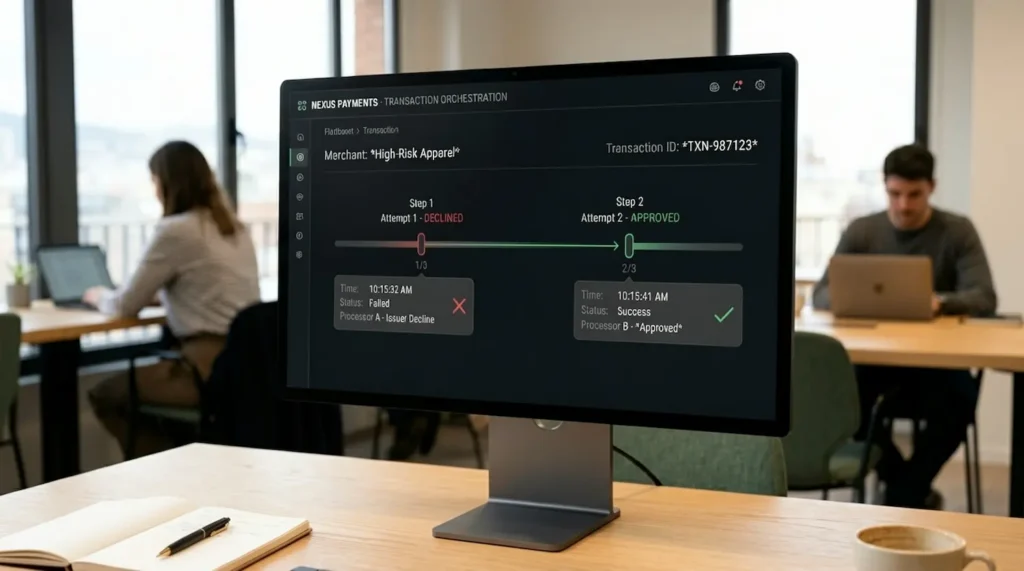
- fallback options in case of declines
- coverage across different geographies and risk profiles
The goal is not complexity for its own sake. The goal is control.
Payment routing becomes the core layer
At the center of any multi processor setup for high-risk merchants is payment routing.
Routing determines how each transaction is handled:
- which processor receives it
- how it is matched based on geography or card type
- whether it should be retried through another route
Without routing, multiple processors do not add much value. With proper routing, they become a performance advantage.
Merchants using advanced routing can:
- increase approval rates
- reduce dependency on a single provider
- improve consistency across different markets
That is why payment routing is not just a technical detail. It is the foundation of scalable payment infrastructure.
Supporting cross-border growth
For merchants operating internationally, cross-border high-risk payments introduce another layer of complexity.
Different regions have different:
- issuing bank behaviors
- regulatory expectations
- fraud patterns
- approval dynamics
A single processor rarely performs equally well across all markets. A multi processor setup for high-risk merchants allows transactions to be routed through providers that perform better in specific regions.
This improves approval rates and reduces friction for international customers, which is critical for businesses expanding across EU, UK, US, or global markets.
Reducing risk and improving resilience
High-risk merchants operate in environments where stability cannot be taken for granted.
Accounts can be:
- reviewed
- restricted
- repriced
- or even paused unexpectedly
With a single processor, any disruption directly impacts the entire business. With a multi processor setup for high-risk merchants, that risk is distributed.
If one route underperforms or becomes unavailable, transactions can continue through alternative processors. This level of redundancy is essential for maintaining consistent revenue flow.
Use cases where multi-processor setups are critical
Not every merchant needs a multi-processor setup immediately, but in certain verticals, it becomes necessary much faster.
For example:
Forex and trading platforms
Businesses using a payment gateway for forex brokers often deal with higher volatility, international traffic, and stricter compliance requirements. Multiple processors help maintain approval stability across regions and payment methods.
Crypto exchanges and OTC desks
Merchants operating with a payment gateway for crypto exchanges or OTC models face additional scrutiny from banks and regulators. A multi-processor setup helps manage risk exposure and maintain continuity.
High-volume ecommerce and subscription businesses
As volume increases, so does the need for routing flexibility and risk distribution. A single processor may struggle to maintain consistent performance under higher load.
In these environments, a multi processor setup for high-risk merchants is less of an optimization and more of a requirement.
Aligning infrastructure with business growth
As merchants scale, their payment infrastructure needs to evolve with them.
A multi processor setup for high-risk merchants allows businesses to:
- test different acquiring strategies
- optimize approval rates over time
- adapt to new markets
- respond to changes in risk perception
This is not only about performance. It is about long-term flexibility.
Businesses that rely on a single setup often reach a ceiling. Those with a multi-processor approach can continue to expand without being constrained by one provider’s limitations.
When to move to a multi-processor setup
There is no fixed moment when every merchant should switch, but there are clear signals:
- approval rates start to fluctuate
- expansion into new regions is planned
- dependency on one provider feels risky
- decline rates increase without clear reason
- scaling volume creates operational pressure
When these signs appear, it is usually time to consider a multi processor setup for high-risk merchants.
A smarter approach to payment infrastructure
A multi processor setup for high-risk merchants is not just about adding more providers. It is about building a payment system that can adapt, scale, and protect revenue under different conditions.
At NiftiPay, we help high-risk merchants build payment infrastructures that go beyond a single gateway. By combining multiple processors, intelligent routing, and market-specific strategies, businesses can improve approval rates, reduce risk, and operate with greater confidence.
If your business is starting to outgrow a single provider, the next step is not just adding another gateway at random. It is building a setup that fits your risk profile, markets, and growth goals. To discuss your requirements, you can complete the NiftiPay New Client Service Request Form and our team will review your business needs in more detail.
Leave a Reply