
High-risk merchants are increasingly routing funds through stablecoin settlement for high-risk merchants. Replacing T+3 to T+7 bank wires with USDT payouts delivers near-instant finality, predictable fees and a treasury workflow that no longer depends on a single acquiring bank — faster cash flow, fewer disputes and a measurable drop in payment friction.
What is stablecoin settlement for high-risk merchants?
Stablecoin settlement for high-risk merchants is a payout model in which a payment processor settles a merchant’s net balance in a fiat-pegged token — most commonly USDT — instead of in domestic currency through the banking rails. The merchant receives the funds directly into a self-custodial or institutional wallet on a public blockchain.
For verticals that traditionally face long underwriting cycles, rolling reserves and chargeback exposure, this changes the economics of every transaction.
Why does traditional settlement create friction in high-risk verticals?
Card networks and acquiring banks classify a merchant as high-risk when the category shows elevated chargeback ratios, regulatory complexity or reputational exposure. The downstream consequences are familiar to operators:
- Settlement delays of three to seven business days, often extended by weekend cut-offs.
- Rolling reserves of 5–15 % withheld for 90 to 180 days as a chargeback buffer.
- FX spreads of 2–4 % on cross-border volume.
- Account closures triggered by sudden volume changes or category re-scoring.
- Wire fees of USD 25–50 per outbound transfer, plus intermediary deductions.
Each of these is a form of friction — and each is a reason high-risk payment settlement is being re-architected around blockchain rails. The cost picture is striking once high-risk payment processing fees are added up across a quarter.
How does USDT settlement reduce payout delays?
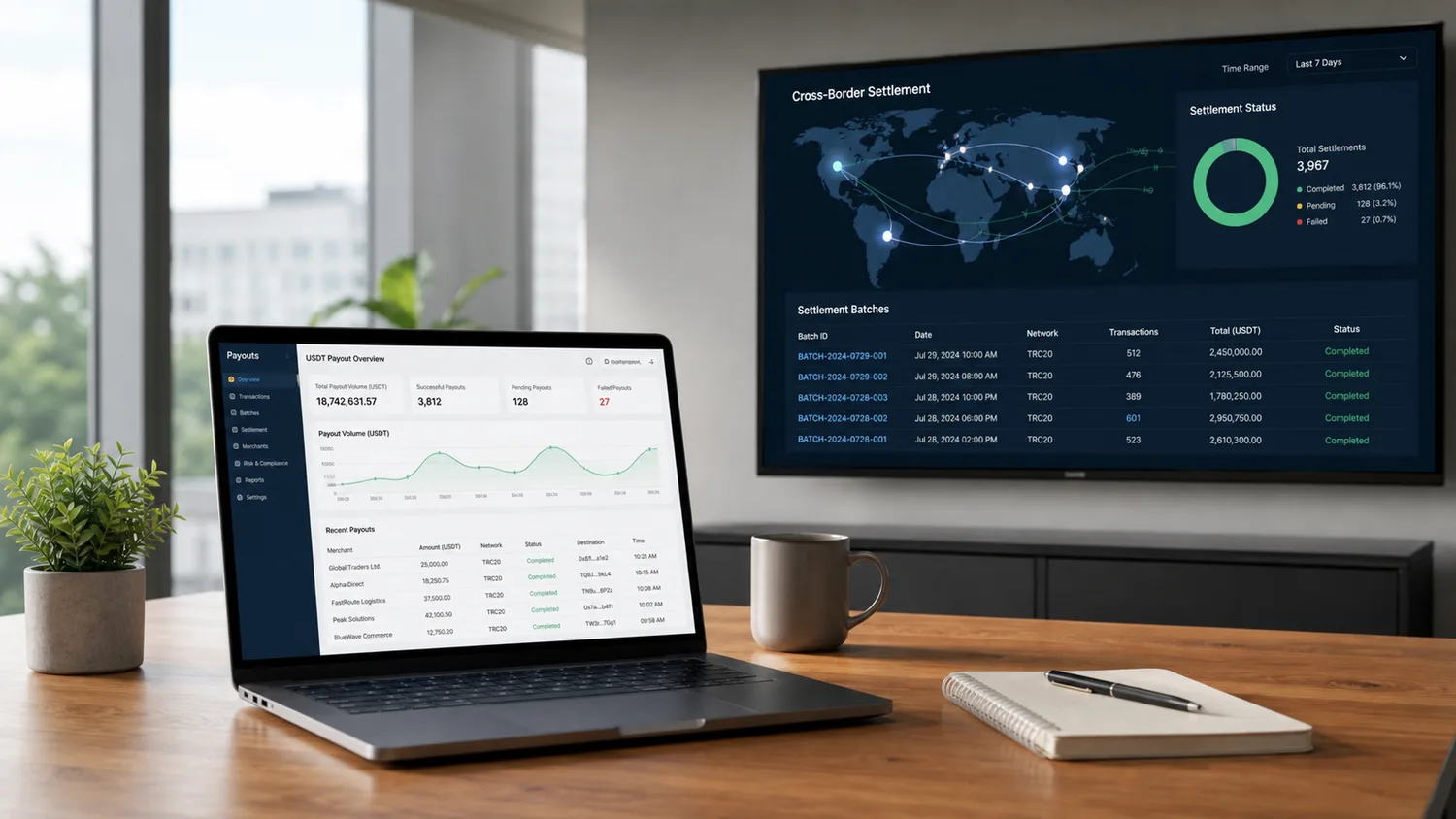
USDT settlement runs on public networks such as Tron (TRC-20), Ethereum (ERC-20) and low-fee L2s. Once a processor signs a batch, the value moves on-chain in seconds and is final within a few confirmations — no banking cut-offs, no SWIFT chain, no FX conversion at payout.
Faster reconciliation and treasury operations
Because every payout is an on-chain transaction with a deterministic hash, reconciliation moves from end-of-day banking files to real-time API queries against the chain. Finance teams gain a continuous view of merchant balances.
Lower fees and fewer chargeback dependencies
A USDT transfer on a high-throughput chain typically costs cents, not tens of dollars. Combined with the absence of card-style chargebacks at the settlement layer, stablecoin payouts narrow the fee envelope significantly for cross-border merchants.
Where are stablecoin payouts gaining traction?
Crypto settlement for businesses is no longer a niche request. The verticals adopting it fastest share a common profile: globally distributed customers, frequent payouts, and historic difficulty maintaining stable banking relationships.
- Online gaming and iGaming operators paying suppliers and affiliates worldwide.
- Forex and CFD brokers settling with introducing brokers across jurisdictions.
- Adult-content platforms paying creators on weekly or daily cycles.
- Nutraceutical and supplement merchants serving cross-border subscription bases.
- Digital asset marketplaces and OTC desks rebalancing inventory.
What should merchants consider before switching to crypto settlement?
Stablecoin rails introduce their own controls. Issuer transparency (reserve attestations, frozen-address policies), chain choice, wallet custody (self-custody, MPC or qualified custodian) and on-chain analytics for KYT/AML are the four axes that matter most. Regulatory positioning should be reviewed jurisdiction by jurisdiction; the EU’s MiCA framework, ongoing US legislation, and Travel Rule obligations at the on/off-ramp interface are all in active flux through 2026.
Key takeaways
- Speed. Payout finality compresses from days to minutes.
- Cost. On-chain transfer fees are a fraction of international wire fees.
- Resilience. Multi-chain, multi-processor setups remove the single-bank dependency.
- Compliance. Issuer transparency, KYT analytics and licensing are decisive controls.
- Treasury. Real-time on-chain reconciliation replaces end-of-day banking files.
FAQ — Stablecoin payouts for high-risk businesses
Is stablecoin settlement legal for high-risk merchants?
Yes, in most major jurisdictions, provided the processor is licensed where required and the merchant complies with local AML, tax and reporting obligations. Frameworks such as MiCA (EU), FinCEN guidance (US) and VARA (UAE) define the operating perimeter.
How fast are USDT payouts compared to bank wires?
Settlement finality on Tron or a major L2 is typically reached within minutes, versus three to seven business days for international bank wires. Operational latency depends on the processor’s batching cadence, not the rail.
Do merchants need their own crypto wallets?
Not necessarily. Processors offer custodial wallets, MPC-secured institutional wallets and direct-to-self-custody flows. The choice is a treasury and compliance decision.
What happens if USDT depegs?
Short-term deviations are the main scenario; major issuers maintain reserve attestations and have historically restored peg quickly. Many merchants diversify across USDT and USDC, or schedule rapid off-ramps to fiat.
Can chargebacks still happen with crypto settlement?
Chargebacks remain a card-network mechanism between cardholder and acquirer. Stablecoin settlement removes chargebacks at the payout layer, but card disputes upstream still need to be managed by the processor and merchant.
Beyond the banking calendar
The structural drivers point in one direction: settlement that follows the cadence of the business, not the calendar of the bank. Merchants who spent years engineering around card cut-offs and reserve schedules now have a credible alternative — and the operators moving fastest are the ones treating stablecoin rails as a treasury redesign rather than a payout swap. Niftipay has been working alongside iGaming, forex and digital-asset businesses as they make this transition, and the pattern is consistent: faster payouts unlock more flexible treasury, and more flexible treasury unlocks tighter liquidity. Operators ready to take the next step can explore a USDT payment gateway built for high-risk businesses.
To explore how stablecoin settlement could fit your specific vertical, complete the NiftiPay new client service request form. The team will review your setup and follow up with the rails, custody and routing options that match your business profile.
Leave a Reply