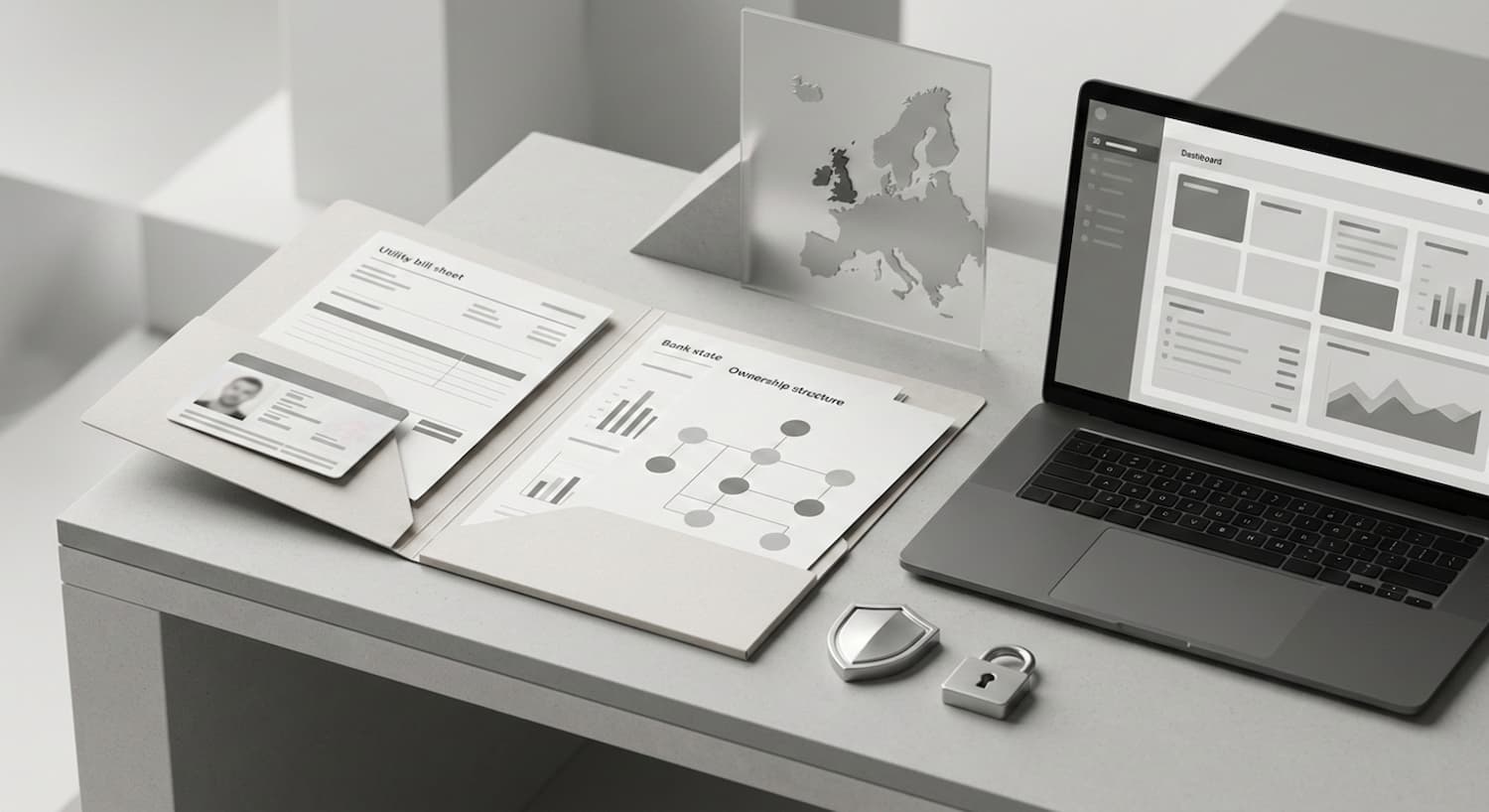
Applying for a high-risk merchant account shouldn’t feel like a scavenger hunt. Yet most “delays” happen for one simple reason: underwriting can’t verify something quickly—ownership, banking, website compliance, or how you handle disputes.
This article gives you a practical high risk merchant account application checklist so you can gather the right documents before you apply, reduce back-and-forth, and move through onboarding faster—especially if you’re operating in the UK and EU.
What underwriting is really trying to confirm
Underwriters don’t ask for extra paperwork just because you’re “high-risk.” They’re assessing whether your business is:
- Legitimate (KYB-ready): real company, real people, traceable ownership
- Operational: clear product/service delivery, accessible support, transparent policies
- Financially coherent: bank statements match the business, projections make sense
- Risk-manageable: chargeback prevention, refund clarity, dispute response plan
- Compliant in market: UK/EU consumer rules, privacy standards, and restricted-market logic
If you prepare for those five points, you’re meeting the intent behind “high risk merchant account requirements,” not just uploading random PDFs.
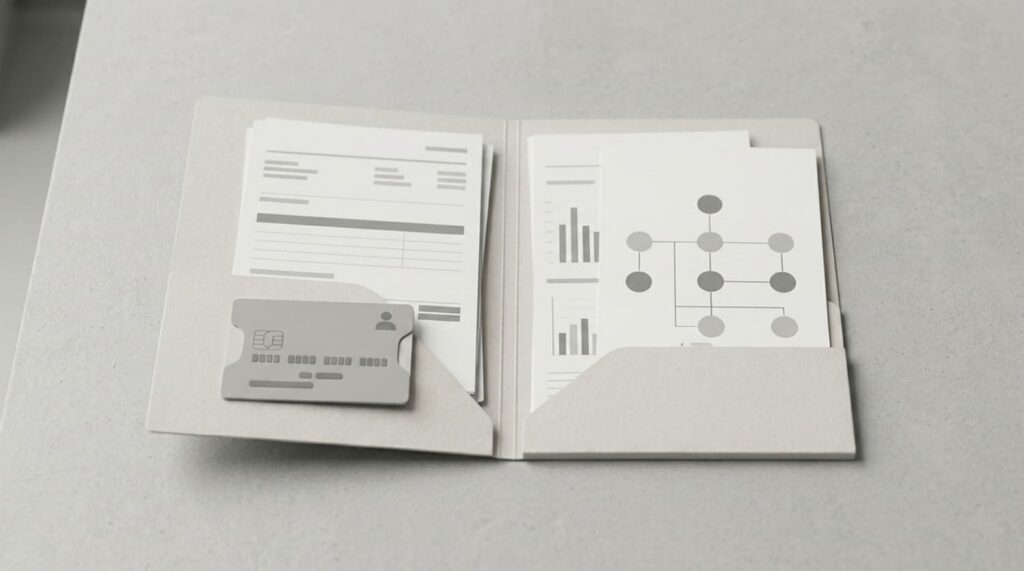
High risk merchant account application checklist: documents to collect
Below is the core list of documents needed for a high risk merchant account. Requirements vary by provider, but this covers what most onboarding teams request across UK/EU.
Business identity and registration (KYB fundamentals)
- Certificate of incorporation / company registration
- Articles of association (or equivalent formation documents)
- Proof of business address (utility bill, lease, or official register extract)
- Tax identifiers (UK UTR if applicable; EU VAT ID where relevant)
- Trade name/DBA documentation (if you operate under a brand name different from the legal entity)
Make it easy: Ensure the legal name and address match across documents. Small mismatches are a common cause of “silent delays.”
Ownership and UBO verification
- Government-issued ID for beneficial owners and key directors
- Proof of address for beneficial owners (recent utility bill/bank letter)
- Ownership structure chart (especially if you have holding companies or multiple entities)
- Director/officer register (where applicable)
This is what many teams mean by high risk merchant account underwriting documents—they need a clean, traceable ownership picture.
Banking and financials
- Business bank account details (IBAN/SWIFT for EU; UK sort code/account)
- Business bank statements (commonly last 3–6 months)
- Basic financials (P&L / balance sheet) if you’re applying for higher volume or larger tickets
- Explanation note for seasonality or spikes (a short paragraph can prevent confusion)
Why it matters: Underwriters use bank statements to confirm stability and match business activity to your stated model.
Processing history (if you’ve processed before)
- Previous processor statements (typically 3–6 months)
- Chargeback and refund ratios (if available)
- Dispute reason trends (even a simple summary helps)
- Any prior reserve/hold details (and context)
If you have it, processing history often speeds decisions because it replaces guesswork with evidence.
Website, checkout, and customer journey proof
Underwriting will review your site like a skeptical customer.
Prepare:
- Live website URL (fully functional, not “coming soon”)
- Product/service pages with clear pricing and what customers receive
- Checkout flow screenshots (especially if parts are behind login)
- Subscription details (billing cadence, cancellation method, trial terms if any)
- Delivery/fulfillment proof (shipping, digital access, appointment booking, etc.)
UK/EU note: If you serve multiple countries, show how you handle currencies, delivery timelines, and support coverage.
Policies that prevent disputes (non-negotiables)
- Refund/return policy (clear timelines, conditions, and method)
- Shipping/delivery policy (timeframes, tracking, digital delivery details)
- Terms and conditions
- Privacy policy + cookie policy (UK GDPR / GDPR aligned)
- Support/contact page (email at minimum; response expectations clearly stated)
A vague refund policy almost always turns into higher disputes—underwriting knows it.
Compliance and licensing (industry-dependent)
Because Niftipay supports multiple high-risk verticals, your documentation here depends on what you sell and where.
You may be asked for:
- Industry licenses/authorizations (where required)
- Supplier agreements or proof of distribution rights (where relevant)
- Age verification approach (if applicable)
- Restricted-market rules (where you do/don’t sell, and why)
- Marketing compliance notes (especially if your category is sensitive)
If you operate across UK + EU, a simple “Markets Served” page or PDF summary can reduce follow-ups.
Operations, support, and risk controls
- Customer support SOP (even 1–2 pages is enough)
- Chargeback process (monitoring, response timelines, escalation)
- Fraud prevention overview (3DS/SCA approach, velocity rules, manual review triggers)
- Fulfillment workflow (warehouse/3PL proof or digital delivery mechanism + SLAs)
This is where providers decide if your risk is manageable, not whether your business is “good” or “bad.”
Security and technical readiness
Not always requested, but common:
- Checkout security summary (hosted checkout, tokenization, platform used)
- If API-based: a short description of your integration setup (Shopify/WooCommerce/custom)
- Data handling note (where customer data is stored and who has access)
For UK/EU, showing you’re aligned with strong authentication and privacy expectations builds confidence.
How to package your submission so it gets approved faster
Even with perfect documents, messy submissions slow everyone down. Use a simple structure:
Folder: CompanyName_Onboarding_Pack_YYYY-MM
Subfolders:01_Company / 02_Ownership / 03_Banking / 04_Processing / 05_Website / 06_Policies / 07_Compliance / 08_Ops_Risk
File naming: CompanyName_DocumentType_Date.pdf
Add a one-page summary (seriously—this helps):
- What you sell + how delivery works
- UK/EU markets served + currencies
- Expected monthly volume + average ticket
- Support channels + response times
- Risk controls (chargeback + fraud, bullet points)
Common reasons high-risk applications get delayed
Inconsistent information
Different company address formats, mismatched director names, or outdated documents.
Website red flags
Missing policies, unclear pricing, no accessible contact info, or confusing checkout.
Unrealistic projections
Claiming large volume with no processing history or operational capacity to support it.
No dispute plan
If you can’t explain how you prevent and handle chargebacks, underwriting slows down.
Cross-border ambiguity
If you serve UK + EU, be precise about delivery, returns, languages, and support coverage.
Copy/paste checklist (quick version)
- Company registration + formation docs
- Proof of business address
- Tax/VAT identifiers (as applicable)
- UBO IDs + proof of address
- Ownership chart (if complex)
- Business bank statements (3–6 months)
- Processing history statements (if available)
- Live website + checkout proof
- Refund, delivery/shipping, T&Cs, privacy + cookies
- Support SOP + dispute handling plan
- Compliance/licensing (if required)
- Fraud prevention + 3DS/SCA approach summary
Where Niftipay fits (without slowing your application)
Niftipay is built for high-risk businesses across UK and EU, so your vertical may change—but the onboarding logic doesn’t: underwriting still needs clear KYB, operational proof, policies, and risk controls.
If you want to reduce back-and-forth, a good next step is to book a demo and we’ll show:
- What an “underwriting-ready” onboarding pack looks like
- How to present risk controls and processing history clearly
- The fastest way to align website/policies with UK/EU expectations
If you’re preparing to apply, keep this high risk merchant account application checklist as your pre-application pack and update it as your business scales.
Leave a Reply